Over two weeks ago Lancia released several official images of the upcoming Delta, with a short press release. Today, Lancia decided to reveal more with an 'extended' press release that covers almost everything you need to know about the hot hatch.
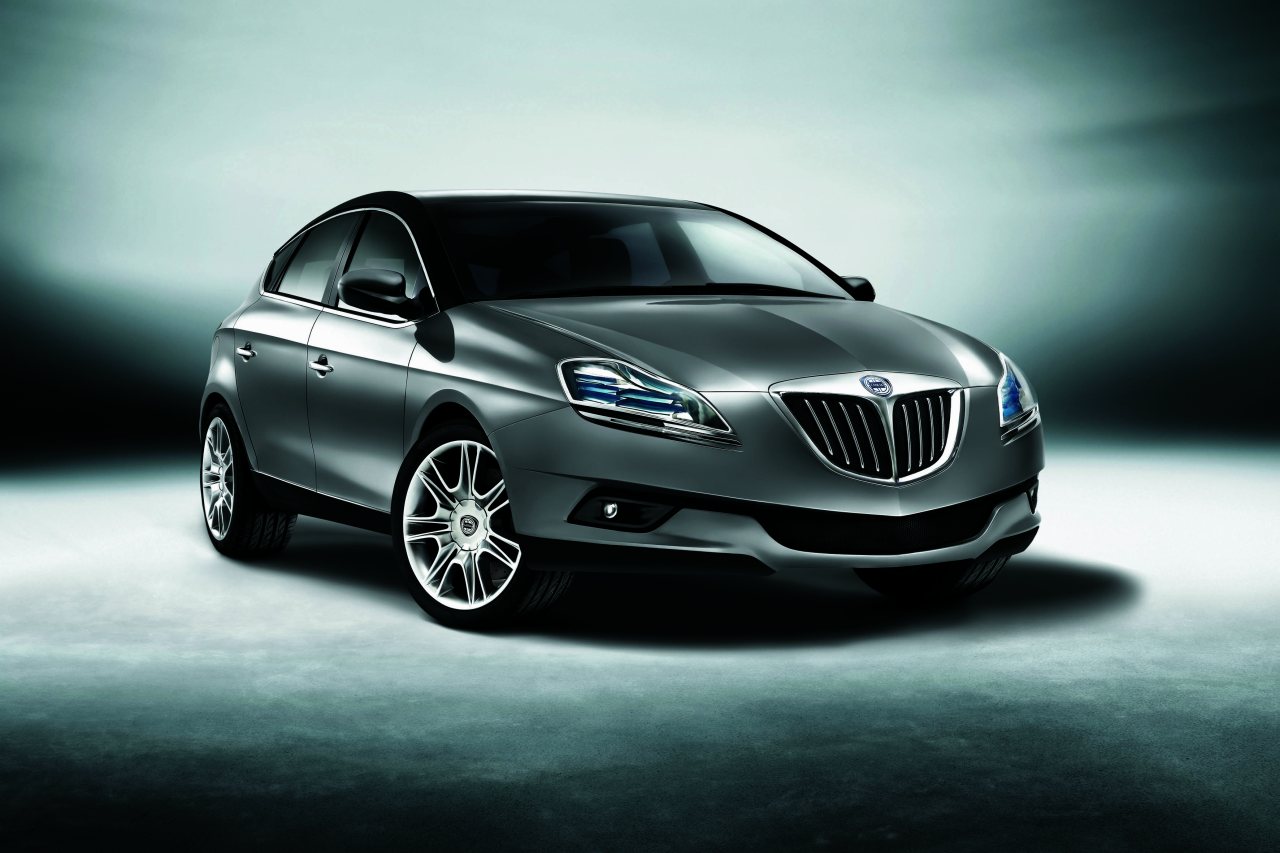
The Delta is 4.5 metres long, 1.8 metres wide, 1.5 metres high, and has a wheelbase of 2.7 metres that allows for plentiful interior space. The exterior appears very contemporary, particularly with the front nose that is exceptionally aggressive.
At launch, buyers can select between the 120 hp 1.4 litre and 150 hp TurboJet petrol engines, or the 1.6 litre 120 hp MultiJet turbodiesel engine. The engines are mated with a 6-speed manual, robotized, or automatic gearbox. More engines will be added in the future, including the 2.0 litre 165 hp MultiJet, 1.9 litre 190 hp Twinturbo MultiJet, and the all new 1.8 litre 200 hp Di Turbojet (petrol).
The car is highly customisable in respect of exterior and interior looks. Other features include climate control, Blaukpunt radio, Hi-fiBose® sound system (optional), CD and MP3 player, and a new satellite navigation system.
Press ReleaseLancia Delta, global premiere
Delta, a historical name representing one of the peaks of Lancia's automotive history but also a mathematical symbol which represents change, difference, evolution.
In this sense, Lancia Delta is one of the first cars in a new Lancia philosophy. A unique and original position, synthesis of two fundamental Lancia brand values, the elegance of style and the audacious innovative nature, which inspires every marketing and communication activity.
This is the first totally new vehicle in the second Lancia centenary, the Delta. Blessed with an unrivalled design faithful to the innovative calling of the brand. For the product features and international development work backing the launch predicted for the middle of 2008, Delta represents a turning point in Lancia's history and will contribute significantly to the strategic plan.
Perfect stylistic balance for the Lancia of the future.
The first advanced “delta” is represented by the capacity to reconcile the traditional elegance of Lancia with original architectural solutions, which for the first time combine harmoniously the plucky personality of a sport vehicle with the on-board comfort of a saloon.
Designed by the Centro Stile Lancia, the new Delta brings into the future the tradition of the “great” Lancias – such as the Aprilia, Appia, Fulvia, Beta, Prisma, Dedra and the Lybra. Back in the fore-front is the medium sized saloon. Delta is 4,5 metre long, 1,8 metre wide and 1,5 metre high. Measurements, which when coupled to a wheelbase of some 2,7 metres, guarantee an extraordinary habitability for it's segment.
The nose of Lancia Delta is aggressive and important, emphasised by the volume of the mudguards and characterized by an imposing radiator grill, brand-name symbol. A harmonious convergence of the well sculpted bonnet and the fluid lines of the wheelhouse, while the dynamic aspect of the vehicle is underlined by the broad air intake, witness to the fiery temperament of the Lancia Delta. Rendering the vehicle even more sporty and technological is a set of innovative spotlights, true high-tech engineering jewels, framed by a line of LED's.
Sidewise, the Lancia Delta shows great dynamism, with a high beltline and trapezoidal rear pillars, a natural support for the nautically inspired “flying bridge” roof. Contributing to the smooth lines of the vehicle are both the chromed moldings - perfectly integrated in the weatherstrips emphasising the “flying bridge” – and the opaque grey chromatic contrast in the lower-part of the door sill, which recalls the roof's two colours, in clear homage to the Lancia tradition.
The broad glazed roof surface – with a specific diverging development of the uprights towards the rear area – terminates in the spoiler, perfectly integrated with the original wraparound backlight and the modern conception which does away with the perimeter structure. And the same stylistic originality can be found in the rear, where the vertical LED headlamps, an expression of advanced technology, further enhance the elegant Lancia Delta lines.
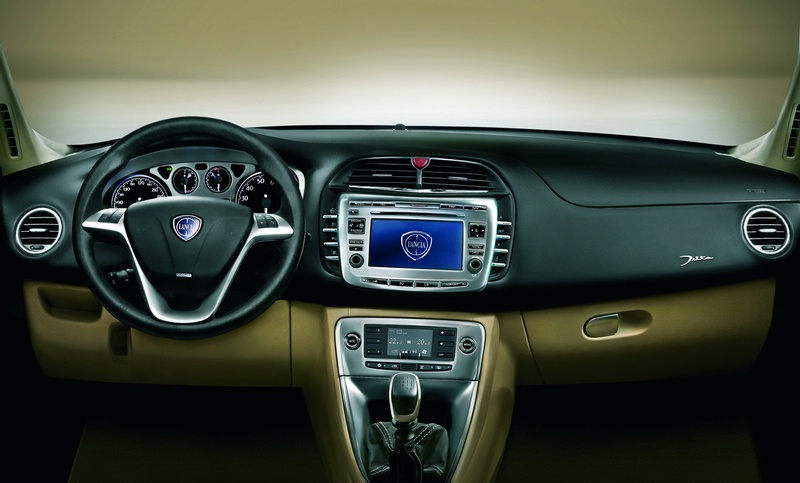
A fascinating and innovative range, that finds a perfect balance in the interior – quiet, bright, rich in luxurious materials and harmonious colours – guaranteeing unrivalled comfort. As shown by the sound absorbing roof panel which ensures a quiet drive, while the generously dimensioned side windows provide plenty of light, together with he optional extralarge sunroof which takes up 80% of the total surface. An exclusive wide and protective space is born: like the interior of a Lancia car should be. Fully in line with the Lancia tradition, the front area is characterized by soft surfaces and linings in high-quality material. From leather to Alcantara – and a “important” dashboard made with Benova®, an innovative material and noble polyurethane base product which features the same tactile and visual sensations as real leather (the product is registered by Benecke-Kaliko and has up to now been used in top of the line vehicles, such as the Maserati).
Furthermore, the central console is particularly attractive, as the “ideal technological plate” seems to “fluctuate” upon the surface below. This ideal overlapping is further emphasised by the original white lighting which spills out of the console and illuminates the buttons of the original three-dimensional form. In addition, all driving controls - console, driving-wheel, climate controls and the “infotainment” application – have been given the same chromatic treatment and are made of the same materials, with a metallic and technological effect which enhances the entire dashboard, to underline their important function.
The unmistakable Lancia class can be seen in the chromed detail on the controls: from the climate control and radio dials, to the door handles and console controls. At the same time, the steering-wheel of the new Delta recalls, in a contemporary key, the historical “four spoke”, and the same applies to the elegant gearshift knob.
Comfort and pleasant well-being also for those who recline on the rear seats. Not only because they are real armchairs which provide excellent comfort, but also due to the rear habitability of the new Lancia Delta (which has a wheelbase of over 2,7 metres) being among the best in the range. The interior becomes a living room, thanks to the sliding rear seat with adjustable back, which further increases the capacity of the already spacious boot. By tilting or backing the seat, total relaxation is on hand, full extention becoming available as on business class seats of intercontinental flights.
Innovative technology for maximum on board comfort
The highest expression of sought-after Italian exclusivity, the Lancia Delta compartment confirms itself as a veritable living-room able to accommodate passengers in a unique environment for class and comfort, as well as being highly technological.
Thanks to a collaborative effort with the best partners in each sector, the Lancia Delta offers the most advanced accessories and systems in the entertainment field: for example, you can experience the exciting musical quality of the Blaukpunt radio, or the Hi-fiBose®sound system (optional) with CD and MP3 player complete with controls on the steering wheel. Otherwise, you can access the innumerable features of the Blue&Me®, a system made in collaboration with Microsoft, fitted with: Hands-off and Bluetooth® interface and advanced voice recognition, USB port, MP3 player and SMS interpreter (also available in SatNav version).
Lastly, debuting on the Lancia Delta is a brand new satellite navigation system. Designed in cooperation with Magneti Marelli, this innovative device offers high multi-media performance, great ease of use, and perfect integration of a host of features in one system: from USB interface to voice commands and map management through SD cards on the high-definition screen.
Engine and mechanics with elegance and temperament
The Lancia Delta expresses it's cardinal values – elegance and temperament – even in the engines and mechanics. Before anything, the “temperament” of its petrol and diesel power units are distinguishable by the innovative technology and performance. All turbocharged and coupled to 6-speed transmission (manual, robotized or automatic). The Lancia Delta engines available from launch will be three: 1.4 litre, 120 HP and 150 HP TurboJet (both petrol) and the 1.6 litre 12° HP MultiJet turbodiesel (Euro 5), which will also be coupled to an advanced robotized transmission. To these will be added 2 new engines: the 2.0 MultiJet with 165 HP and the 1.9 Twinturbo MultiJet with 190 HP.
Subsequently the range will be completed by another innovative engine: the 1.8 Di Turbojet with 200 HP (direct fuel injection mated to a modern automatic 6-speed gearshift). All Euro 5, these three units confirm the Lancia brand as an industry standard in terms of technology and innovation for the entire automotive panorama.
Elegance in the forms and materials, but also “elegance” in their relationship with the outside world. As regards the environment, the Lancia Delta by using diesel engines, anticipates the limits imposed by the future Euro 5 norms. This characteristic surely adds another “delta” on top, in comparison to the competition.
Lastly, the engine performance is tested mechanically and optimized for comfort and handling via the use of technical solutions unique in their field. Starting with the ESC(Electronic Stability Control), an evolved system stability control, which in comparison to the systems available up to now, adds numerous and important functions, such as for example the LTF (Linearization Torque Feedback) which noticeably improves the road handling feel curves, especially at high-speed; and the TTC (Torque Transfer Control), an innovative function which – by simulating electronically the presence of the self-locking differential – improves traction on turns, noticeably diminishing understeer and ensuring more dynamicity in the drive.
It's worth mentioning that the innovative control system ESC always intervenes in a discreet manner thanks to the DST (Drive Steering Control). In fact, the “active electronic steering wheel” already carries out the adjustments and controls the oversteer on slippery surfaces.
Still at the forefront of technological advances, the Lancia Delta adopts the SDC (Synaptic Damping Control) suspension, which, on one side improves the ease of shifting gears, in particular elevating the filtering on uneven surfaces; on the other, it exalts yet further driving pleasure by improving the road handling under any conditions (the system actively regulates the stability depending on the driving surface and driving technique).
Completing the set-up is a semi-automatic parking system SPS (Semiautomatic Parking System) which guides the steering, leaving to the driver the task of accelerating and braking to complete the manoeuvre. The HALF (Haptic Line Feedback) system, helps by acting on the steering, and warning the driver if the vehicle has slipped out of gear.
In synthesis, all these devices have the task of simplifying and improving the driving experience, so much so that – taken all together – they are part of the all-embracing concept of “VIP Driving”.
More than a 1.000 customizations “made to measure”
Aimed at a demanding clientele who love to be distinct, the new Delta combines stylistic elegance with sought-after materials and care in the details, as well as those particular innovations and sporty features, which historically have distinguished the Lancia cars for over a century. It is precisely in the combination of colours, cloths and materials that the model's exclusivity is born. Suffice to say that the client can chose over a 1.000 personalizations. An extraordinary range born by combining 3 outfittings, 4 different seat upholsteries, 3 interior colours, 5 types of alloy wheels, 12 chassis colours and 12 “two-tone” matchings.
Therefore, whatever the level of personalization, the Lancia Delta is always fascinating and original, with full respect for the world famous Italian elegance. The model renews the Lancia tradition, by playing with contrasts, highlighting the importance of detail and artisan work, and offering interiors with sough-after performance, all with the maximum personalization of the different outfits. This is why, every version of the new car is a truly “made-to-measure” suit.
Delta: a name which has entered international motoring history
The Lancia Delta is born in the autumn of 1979, in 1980 it is voted “car of the year” by a jury of specialized journalists. The bodywork has a strong personality, the engine is high-performance, and the model represents a true generation leap, both in terms of the global concept of the vehicle, and for its engineering, style and quality. It's not by chance that the public finds in the delta excellent performance, care in the finish and the generosity of the materials typical of the great Lancia's.
The two-volume body-line owes its debt to the pen of Giorgetto Giugiaro, who gives life to a trapezoidal form with very angular contours. Among the original features are the front and rear bumpers which include the grills made in polyester resin reinforced by glass fibres.
The mechanical architecture is made-up by a front-wheel traction with transverse engine, suspension with four independent wheels, braking system with two crossed circuits and rack and pinion steering. There are two power units available on launch: 1.3 with 75 HP and a 1.5 with 85 HP. Both are fitted with a cam shaft controlled by a toothed belt. The cylinder head is a light alloy casting.
Taken as a whole, the Delta comes across as a compact and elegant car, less than 4 metre long. We are in 1979, and the Delta, a small family car, offers the accessories of a luxury car (including, for example, electric windscreen wipers). The idea of a vehicle with innovative style and features typical of top of the range models, is introduced by Lancia as a compact saloon which received immediate widespread approval from the public and critics alike.
Began in Lingotto, a factory in Turin, production of the Delta is then transferred to the Chivasso plant, which is host to most advanced spray systems in the world. An electronic control system for working on the body and an automated plant which ensures total quality of sub-assemblies. From here roll out the “personalized” LX versions, and in 1982 the Delta GT with a 1.6 105 HP engine. The car is fitted with four disc brakes with brake servo. Top-speed is 180 km/h.
In 1983, four years after the debut, the Delta HF Turbo is born. It's the first standard Lancia car with turbo. The engine is still 1585 cc, but it delivers 130 HP, for a top speed of 190 km/h.
Three years later, in 1986, the model range is renewed and broadened: with a Delta GT electronic injection 108 HP, 2.0 turbo 80 HP, HF Turbo injection (140 HP) and HF 4WD. The latter, together with the Prisma 4WD, marks the entry of Lancia in the 4WD saloon segment. It is fitted with a two litre 165 HP engine (top speed 208 km/h) and advanced mechanics. The traction system includes front differential, epicyclic central differential which distributes torque asymmetrically (56% to the front axle and 44% to the rear), a viscous Ferguson joint applied to the central differential and a Torsen (“torque sensing”) differential at rear, an intelligent device which distributes torque between the two wheels depending on adhesion without completely locking the two half shafts. In this way the Delta HF 4WD can transfer to the ground all the engine power in the correct manner. The result is a vehicle with great motricity on low-adhesion surfaces and excellent road handling at high speeds. In subsequent years, the all-wheel drive Delta is made even more appealing by a series of styling and technical improvements, especially dictated by demands from the world of competition. Between 1987 and 1992 the Delta sport models are six time winners of the World Rally Championship
The Delta was in production from 1979 to 1994. Almost half a million units were produced.