Showing posts with label Supercars. Show all posts

Sunday, October 3, 2010

2011 RSC Raptor GT


Manufactured in Germany, RSC’s newest supercar sports a front-mid-engine design and is rear-wheel drive. The RSC Raptor GT is powered by a 2.6-liter rotary engine that's available in four versions, with power outputs ranging from 500 hp, to 1,200 hp. The RSC Raptor GT S is the base model, equipped with Dry Sump, it develops 500 hp. The RSC Raptor GT RS has a water-to-air turbocharger system and develops 800 hp and the RSR has a twin-turbo and outputs a massive 1,200 hp.

The Raptor GT will be sold with different spec-variants called the GT S, RS, RSR and N-spec. Depending on which model, engine configurations vary and include a water-to-air inter-cooled turbo or a bi-turbo system. The engine is coupled to an 8-speed RSC R-Shift transmission with a hydraulic shift mechanism which makes gear changes in 25 to 35 milliseconds.

Inside, the RSC Raptor GT is also said to feature a pair of seven-inch digital displays coupled with a five-inch tachometer, gear indicator and shift lights, the entire package supposedly weighing in at a claimed 2,425 pounds. RSC also plans an all-wheel drive, mid-engine project with similar specs, which seems like a lot to bite off while they still appear to be chewing on this one.

Depending on the model, the body is of 80% glass fiber or carbon fiber and differs in details in the form and aerodynamics. The interior will get two 7" full-graphic-Diyplays, high-quality materials like carbon fiber, brushed aluminum and various types of leather.


RSC Raptor GT RSC Raptor GT RSC Raptor GT


Press Release

Rotary Super Cars Germany is a young company with the goal of offering symbiosis of high performance vehicles and active environment to create new benchmarks in the areas, power efficiency, value for money or the use of high-tech materials.

Since there is no vehicle that meets all these requirements, the construction of the RSC Raptor GT™ started in 2009. Systems such as the VAS (variable aerodynamic system) were developed and brought to small series production. This vehicle meets all requirements or exceed them. With enthusiasm and passion of our team involved in the development and production of the Raptor GT™. We guarantee the best workmanship and highest individuality. The selective use of proven components increases the active/passive safety while reducing production costs, which ultimately benefits every buyer.

With the Raptor GT™, we give our customers the opportunity to experience the unique combination of high end components and environmental protection on the roads and racetracks of the world. The Raptor GT™ doesn't follow the standard in many areas, he goes a very unique way with his drive and approach design. Each vehicle is handmade and unique, which corresponds exactly to the needs and wishes of the owner.

Drivetrain:
The RSC Raptor ™ GT S, RS, RSR and N-Spec does not have a conventional drive system as used in most of today's super sports cars. He has a self-developed and heavily modified, based on parts of the Mazda 13B MSP, high-performance engine with four rotors (4-Rotor rotary engine) and, depending on the model, a water-to-air intercooled turbo or biturbo system. This engine is the heart of the RSC Raptor GT™ and gives him his very special temperament. The power output of a rotary engine uniformly grows with increasing rpm. The high-performance engine in the RSC Raptor GT™ has the redline set depending on the selected driving mode, up to 7,500 rpm or 9000 rpm. The fuel E85 is used, which is produced from rapeseed. By using this fuel to reduce the emissions by about 90% is feasible.

The sequential 8-speed RSC R-SHIFT transmission in the RSC Raptor GT™ is controlled by a hydraulic shift system with shift times of 25-35 milliseconds. Furthermore, each RSC Raptor GT™ has a carbon-aluminum drive shaft, and an electronically controlled rear axle differential.

The powertrain is controlled by an engine management system, specifically developed from Bosch Engineering GmbH for the RSC Raptor GT™, including a complete electronic system consisting of ESP, ABS, EBD, VAS, R-TRAC (traction control), R-DIFF (electronic differential) and a Launch Control. The RSC Raptor GT™ RSR and N-Spec also has an active suspension. All electronic systems can be easily operated via the buttons on the steering wheel.

Body/Chassis:
Depending on the model the body of the RSC Raptor GT™ is of 80% glass fiber or carbon fiber and differs in details in the form and aerodynamics. Furthermore a wide range of special equipment is available. Starting with the rims, complete body equipment packages up to the painting - the customer has no limits.

The RSC Raptor GT™ also has the RSC VAS™ (Variable Aerodynamic System), a system that changes the aerodynamics and the aerodynamic properties of the RSC Raptor GT™ to generate more downforce at high speeds. This system include SBS (Speed Brake System).

Interior:
The RSC Raptor GT™ has two 7" full-graphic-Diyplays, where various telemetry data such as speed, mileage, temperatures, pressures, and the chosen vehicle settings and many other data, are available. These displays create exciting visual effects that show the high-tech genes of the RSC Raptor GT™. They are placed on the left and right of the large 5" tachometer with digital gear indicator and shift light. The driver is always looking at the relevant information and driving a RSC Raptor GT™ becomes a special experience.

The cockpit offers an unique combination of high-quality materials like carbon fiber, brushed aluminum and various types of leather. Many interior equipment packages are available. There also no limits for the customer.

Production levels of the RSC Raptor GT range from the base 500 hp 2.6L 4 rotor rotary to 800 hp turbo and 1.200 hp twin turbo variants. The cars are built in Germany. They are available in left- and right-hand drive configuration.

VelociRaptor:
The second car which is currently in the construction phase. The main facts: Mid-engine, AWD, 8-speed sequential RSC R-SHIFT transmission, RSC VAS, 90% carbon fiber, over 1.200 hp and a weight under 1.100 kg.
This car will set new benchmarks...

Rotary Super Cars Germany
(+49)1511 75 500 98

READ MORE - 2011 RSC Raptor GT

Friday, September 17, 2010

Venom GT Hennessey Supercar

Hennessey Performance Engineering today announced that it is introducing the company's first The Venom GT. Penned by British auto designer, Steve Everitt, the Venom GT would incorporate Hennessey's potent Venom 1000 Twin Turbo Viper V10 powerplant into a light weight mid-engine chassis weighing "under 2,700 lbs". Power would be run through a 6-speed transmission or optional sequential gearbox. With a power to weight ratio of just 2.7 lbs per bhp Hennessey estimates that the Venom GT could attain 0 to 100 km/h times in less than 2.5 sec. and a 0-300 km/h time of around 14 seconds.
Venom GT Hennessey Supercar
“This is not the first time that Britain and America have joined forces to produce a weapon of mass propulsion”, said company founder and president, John Hennessey. “Over fifty years ago the American-built P-51 Mustang fighter aircraft was flown into history powered by a British Rolls-Royce Merlin engine. Today the Hennessey Venom GT promises to set a new standard of power to weight ratio in the rarefied air of today's supercar market.”
Venom GT Hennessey Supercar
In the case of the Venom GT, less weight means more performance. The Venom GT will have a production curb weight of less than 2,400 lbs (1,071 kilos) aided by its lightweight carbon fiber bodywork and carbon fiber wheels. Stopping power is delivered via Brembo brakes with 6-piston calipers up front and 4-piston calipers in rear clamping down on 15-inch carbon ceramic rotors.
Venom GT Hennessey Supercar
The Venom GT’s base power plant is the supercharged 6.2 liter LS9 V8 (the same as in the Corvette ZR1) tweaked by Hennessey to 725 bhp. The company will also be offering 1000 bhp and 1200 bhp twin turbo V8 engine variants. The mid-engine V8 will transmit its power to the rear tires via a Ricardo 6-speed gearbox.
Venom GT Hennessey Supercar
Hennessey plans to manage power output by using a programmable traction control system. CFD (computational fluid dynamic) tested bodywork and down force will also help keep the Venom stable at speed. An active aero system with adjustable rear wing will deploy under varying conditions on both the road and racetrack. An adjustable suspension system will allow ride height adjustments according to speed and driving conditions. Finally, power will be put to the ground via massive Michelin PS2 tires.
Venom GT Hennessey Supercar
Hennessey will be building the power plants at its Texas facility. The engines will then be air freighted to the company's assembly facility near Silverstone, England where the Venom GT is built and tested. Venom GT buyer will be offered a 1-day driver orientation and instruction program by a Hennessey factory test driver, at a track in the UK or USA prior to delivery.
Venom GT Hennessey Supercar

READ MORE - Venom GT Hennessey Supercar

Wednesday, March 31, 2010

2010 Venom GT Hennessey Supercar Concept

Hennessey Performance Engineering today announced that it is introducing the company's first concept car - The Venom GT. Penned by British auto designer, Steve Everitt, the Venom GT would incorporate Hennessey's potent Venom 1000 Twin Turbo Viper V10 powerplant into a light weight mid-engine chassis weighing "under 2,700 lbs". Power would be run through a 6-speed transmission or optional sequential gearbox. With a power to weight ratio of just 2.7 lbs per bhp Hennessey estimates that the Venom GT could attain 0 to 100 km/h times in less than 2.5 sec. and a 0-300 km/h time of around 14 seconds.
Venom GT Hennessey Supercar
The Hennessey Venom GT weights less than 2,400 lbs (1,071 Kg) and to stop the Venom GT, Hennessey added Brembo brakes with 6-piston calipers up front and 4-piston calipers in rear clamping down on 15-inch carbon ceramic rotors. Hennessey plans on building 10 units of the Venom GT annually and four have already been sold at around $600,000 a pop. That means there are only six units left from the first allocation.
Venom GT Hennessey Supercar
SEALY, TEXAS & SILVERSTONE, ENGLAND, March 29, 2010 - Hennessey Performance is pleased to introduce the first official images of its Venom GT supercar. Based upon the Lotus Elise, the Venom GT combines a high-tech, lightweight British chassis with a powerful American V8.
Venom GT Hennessey Supercar
“This is not the first time that Britain and America have joined forces to produce a weapon of mass propulsion”, said company founder and president, John Hennessey. “Over fifty years ago the American-built P-51 Mustang fighter aircraft was flown into history powered by a British Rolls-Royce Merlin engine. Today the Hennessey Venom GT promises to set a new standard of power to weight ratio in the rarefied air of today's supercar market.”
Venom GT Hennessey Supercar
In the case of the Venom GT, less weight means more performance. The Venom GT will have a production curb weight of less than 2,400 lbs (1,071 kilos) aided by its lightweight carbon fiber bodywork and carbon fiber wheels. Stopping power is delivered via Brembo brakes with 6-piston calipers up front and 4-piston calipers in rear clamping down on 15-inch carbon ceramic rotors.
Venom GT Hennessey Supercar
The Venom GT’s base power plant is the supercharged 6.2 liter LS9 V8 (the same as in the Corvette ZR1) tweaked by Hennessey to 725 bhp. The company will also be offering 1000 bhp and 1200 bhp twin turbo V8 engine variants. The mid-engine V8 will transmit its power to the rear tires via a Ricardo 6-speed gearbox.
Venom GT Hennessey Supercar
Hennessey plans to manage power output by using a programmable traction control system. CFD (computational fluid dynamic) tested bodywork and down force will also help keep the Venom stable at speed. An active aero system with adjustable rear wing will deploy under varying conditions on both the road and racetrack. An adjustable suspension system will allow ride height adjustments according to speed and driving conditions. Finally, power will be put to the ground via massive Michelin PS2 tires.
Venom GT Hennessey Supercar
Hennessey will be building the power plants at its Texas facility. The engines will then be air freighted to the company's assembly facility near Silverstone, England where the Venom GT is built and tested. Venom GT buyer will be offered a 1-day driver orientation and instruction program by a Hennessey factory test driver, at a track in the UK or USA prior to delivery.
Venom GT Hennessey Supercar
Hennessey plans on building 10 units of the Venom GT annually and four have already been sold at around $600,000 a pop. That means there are only six units left from the first allocation. The company plans to establish a network of Venom GT dealers and distributors in the Middle East, Europe, Russia, Australia and Asia.
READ MORE - 2010 Venom GT Hennessey Supercar Concept

2010 Venom GT Hennessey Supercar Concept

Hennessey Performance Engineering today announced that it is introducing the company's first concept car - The Venom GT. Penned by British auto designer, Steve Everitt, the Venom GT would incorporate Hennessey's potent Venom 1000 Twin Turbo Viper V10 powerplant into a light weight mid-engine chassis weighing "under 2,700 lbs". Power would be run through a 6-speed transmission or optional sequential gearbox. With a power to weight ratio of just 2.7 lbs per bhp Hennessey estimates that the Venom GT could attain 0 to 100 km/h times in less than 2.5 sec. and a 0-300 km/h time of around 14 seconds.
Venom GT Hennessey Supercar
The Hennessey Venom GT weights less than 2,400 lbs (1,071 Kg) and to stop the Venom GT, Hennessey added Brembo brakes with 6-piston calipers up front and 4-piston calipers in rear clamping down on 15-inch carbon ceramic rotors. Hennessey plans on building 10 units of the Venom GT annually and four have already been sold at around $600,000 a pop. That means there are only six units left from the first allocation.
Venom GT Hennessey Supercar
SEALY, TEXAS & SILVERSTONE, ENGLAND, March 29, 2010 - Hennessey Performance is pleased to introduce the first official images of its Venom GT supercar. Based upon the Lotus Elise, the Venom GT combines a high-tech, lightweight British chassis with a powerful American V8.
Venom GT Hennessey Supercar
“This is not the first time that Britain and America have joined forces to produce a weapon of mass propulsion”, said company founder and president, John Hennessey. “Over fifty years ago the American-built P-51 Mustang fighter aircraft was flown into history powered by a British Rolls-Royce Merlin engine. Today the Hennessey Venom GT promises to set a new standard of power to weight ratio in the rarefied air of today's supercar market.”
Venom GT Hennessey Supercar
In the case of the Venom GT, less weight means more performance. The Venom GT will have a production curb weight of less than 2,400 lbs (1,071 kilos) aided by its lightweight carbon fiber bodywork and carbon fiber wheels. Stopping power is delivered via Brembo brakes with 6-piston calipers up front and 4-piston calipers in rear clamping down on 15-inch carbon ceramic rotors.
Venom GT Hennessey Supercar
The Venom GT’s base power plant is the supercharged 6.2 liter LS9 V8 (the same as in the Corvette ZR1) tweaked by Hennessey to 725 bhp. The company will also be offering 1000 bhp and 1200 bhp twin turbo V8 engine variants. The mid-engine V8 will transmit its power to the rear tires via a Ricardo 6-speed gearbox.
Venom GT Hennessey Supercar
Hennessey plans to manage power output by using a programmable traction control system. CFD (computational fluid dynamic) tested bodywork and down force will also help keep the Venom stable at speed. An active aero system with adjustable rear wing will deploy under varying conditions on both the road and racetrack. An adjustable suspension system will allow ride height adjustments according to speed and driving conditions. Finally, power will be put to the ground via massive Michelin PS2 tires.
Venom GT Hennessey Supercar
Hennessey will be building the power plants at its Texas facility. The engines will then be air freighted to the company's assembly facility near Silverstone, England where the Venom GT is built and tested. Venom GT buyer will be offered a 1-day driver orientation and instruction program by a Hennessey factory test driver, at a track in the UK or USA prior to delivery.
Venom GT Hennessey Supercar
Hennessey plans on building 10 units of the Venom GT annually and four have already been sold at around $600,000 a pop. That means there are only six units left from the first allocation. The company plans to establish a network of Venom GT dealers and distributors in the Middle East, Europe, Russia, Australia and Asia.
READ MORE - 2010 Venom GT Hennessey Supercar Concept

Wednesday, February 24, 2010

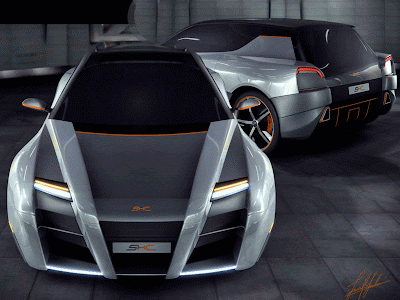
2010 Super Hatchback Concept Car by Jamie Martin

Details on a possible future eco-friendly model, called SHC (Super Hatchback Concept), were revealed by designer Jamie Martin, a UK based designer whose previous works include the Cobra Venom V8 concept and the London Navigator bus. The SHC was conceived out of a desire to fuse the two very different worlds of hatchbacks and supercars. And in a world where limiting CO2 output is becoming increasingly important, the SHC also has some green tech up its sleeve.
2010 Super Hatchback Concept Car by Jamie Martin 
Designed to compete against the likes of the Honda Civic Type-R and Ford Focus RS, the SHC would be offered with a choice of two different engine/transmission packages.
It has similarities to both a supercar and a 3-door hatchback and boasts of both styling and performance characteristics. The concept car is available in a choice of three next generation powertrains, including an electric / hybrid option. Interestingly, the body is composed of 65% Steel and 35% aluminum used for front wings, bonnet & bumpers. Alternatively, 30% glass reinforced plastic can be used for designated sections. 
2010 Super Hatchback Concept Car by Jamie Martin 
Other features include front and rear window ‘air-streams’, combined with hydrophobic and super-fast screen heating and high-intensity LED/Single-Source fiber-optic illumination used on the headlight wing, lower fog light, and rear lights. Martin describes the car to have a “balanced formula of raw power, racing spirit, practicality and eco engine choices.” He said that this means that you have a supercar-inspired drive to use for weekly shopping.
2010 Super Hatchback Concept Car by Jamie Martin 
The first proposed powertrain of the concept consists of a twin-turbocharged internal combustion engine with direct injection, stop-start technology and regenerative braking. Transmission would be via a 6-Speed Short-Shift manual gearbox or a 7-speed paddleshift auto.
2010 Super Hatchback Concept Car by Jamie Martin 
The second option is a system dubbed the 'Delta Drive Hybrid (DDH)'. This setup consists of a smaller displacement internal combustion engine and a pair of electric motors. Nano-Titanate batteries located in the engine bay, and under the floor would feed power to the high-torque electric motors mounted within the front wheels. 3-performance modes would be available: Economy (low bhp town driving), Normal (medium bhp - motorway driving), and Performance (high bhp - utilising both the petrol engine and electric generator together for ultimate power). The car could also be driven in full electric mode for around 70 miles before the engine was needed to recharge the batteries.
2010 Super Hatchback Concept Car by Jamie Martin 
Further highlights of the SHC include a magnetorheological fluid suspension system with Normal, Sport & Track modes. This system, first used by Ferrari, features dampers with iron filings suspended in fluid. When an electrical current is passed through the fluid it instantaneously changes the damping rate and stiffens up the suspension.
2010 Super Hatchback Concept Car by Jamie Martin 
While the SHC is just an independent concept with no intention of production, it does seem more and more likely that hybrid technology will filter very quickly into performance vehicles - and hot hatches could be one of the first segments to make the switch.
READ MORE - 2010 Super Hatchback Concept Car by Jamie Martin

2010 Super Hatchback Concept Car by Jamie Martin

Details on a possible future eco-friendly model, called SHC (Super Hatchback Concept), were revealed by designer Jamie Martin, a UK based designer whose previous works include the Cobra Venom V8 concept and the London Navigator bus. The SHC was conceived out of a desire to fuse the two very different worlds of hatchbacks and supercars. And in a world where limiting CO2 output is becoming increasingly important, the SHC also has some green tech up its sleeve.
2010 Super Hatchback Concept Car by Jamie Martin 
Designed to compete against the likes of the Honda Civic Type-R and Ford Focus RS, the SHC would be offered with a choice of two different engine/transmission packages.
It has similarities to both a supercar and a 3-door hatchback and boasts of both styling and performance characteristics. The concept car is available in a choice of three next generation powertrains, including an electric / hybrid option. Interestingly, the body is composed of 65% Steel and 35% aluminum used for front wings, bonnet & bumpers. Alternatively, 30% glass reinforced plastic can be used for designated sections. 
2010 Super Hatchback Concept Car by Jamie Martin 
Other features include front and rear window ‘air-streams’, combined with hydrophobic and super-fast screen heating and high-intensity LED/Single-Source fiber-optic illumination used on the headlight wing, lower fog light, and rear lights. Martin describes the car to have a “balanced formula of raw power, racing spirit, practicality and eco engine choices.” He said that this means that you have a supercar-inspired drive to use for weekly shopping.
2010 Super Hatchback Concept Car by Jamie Martin 
The first proposed powertrain of the concept consists of a twin-turbocharged internal combustion engine with direct injection, stop-start technology and regenerative braking. Transmission would be via a 6-Speed Short-Shift manual gearbox or a 7-speed paddleshift auto.
2010 Super Hatchback Concept Car by Jamie Martin 
The second option is a system dubbed the 'Delta Drive Hybrid (DDH)'. This setup consists of a smaller displacement internal combustion engine and a pair of electric motors. Nano-Titanate batteries located in the engine bay, and under the floor would feed power to the high-torque electric motors mounted within the front wheels. 3-performance modes would be available: Economy (low bhp town driving), Normal (medium bhp - motorway driving), and Performance (high bhp - utilising both the petrol engine and electric generator together for ultimate power). The car could also be driven in full electric mode for around 70 miles before the engine was needed to recharge the batteries.
2010 Super Hatchback Concept Car by Jamie Martin 
Further highlights of the SHC include a magnetorheological fluid suspension system with Normal, Sport & Track modes. This system, first used by Ferrari, features dampers with iron filings suspended in fluid. When an electrical current is passed through the fluid it instantaneously changes the damping rate and stiffens up the suspension.
2010 Super Hatchback Concept Car by Jamie Martin 
While the SHC is just an independent concept with no intention of production, it does seem more and more likely that hybrid technology will filter very quickly into performance vehicles - and hot hatches could be one of the first segments to make the switch.
READ MORE - 2010 Super Hatchback Concept Car by Jamie Martin

Friday, January 8, 2010

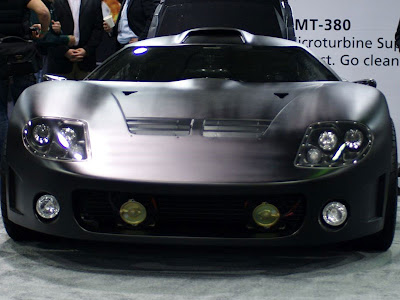
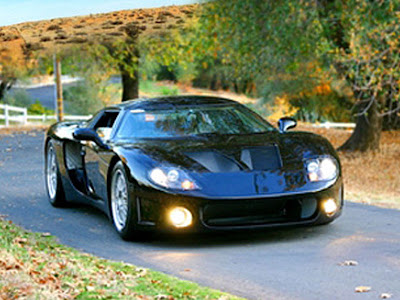
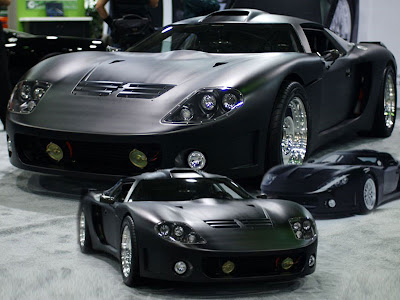
Capstone Supercar CMT-380 the high performance hybrid electric microturbine vehicle Debut at LA Auto Show

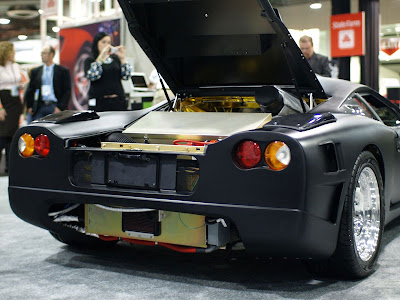
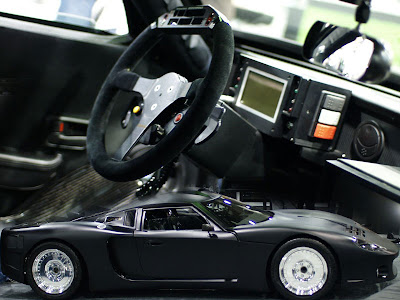
Capstone Supercar CMT-380

The Capstone CMT-380 was the surprise basement find of the LA Auto Show.The Capstone CMT-380 is essentially a prototype show car designed to highlight the technology and products available from Capstone Turbine Corporation. The concept for the high performance hybrid electric microturbine vehicle was developed by Electronic Arts (EA) Chief Creative Director Richard Hilleman.
Capstone Supercar CMT-380

After working on the car for four years, inventor Richard Hilleman was the man of the hour as he fielded questions about his unusual microturbine-lithium-ion hybrid powertrain fitted to a GTM Supercar kit body. It may still be in the test phase, but Capstone claims that the car can reach a top speed of 150mph, and is able to sprint from zero to 60mph in just 3.9 seconds.
The CMT-380 features an unusual hybrid drivetrain which uses one of Capstone's new C30 (30-kilowatt) microturbine engines to extend the range of the primarily electric powered vehicle. The turbine can be run on either diesel or biodiesel.
Capstone Supercar CMT-380

The CMT-380 features lithium-polymer battery cells that can be charged at home or at a public recharging station. While driving, the CMT-380 can operate on 100 percent battery power in zero emissions mode for a range of up to 80 miles. When the batteries reach a predetermined state of discharge, the Capstone C30 microturbine quietly fires up and recharges the batteries on the fly to extend the driving range up to 500 miles. The diesel fueled C30 microturbine requires less maintenance than traditional combustion engines and produces ultra-low exhaust emissions. Hilleman has owned an electric vehicle – a converted Porsche 550 Spyder – for at 15 years and has constantly upgraded it. The EV used to have just 30 hp with lead acids but now uses lithium ferrous batteries and has 200 hp. The 100-mile range hasn't changed, though, and so he knew it was time to build a hybrid. He decided on Capstone's diesel microturbines as the range extender.
Capstone Supercar CMT-380

He knew he could rely on them – they've been used in buses for years – but there was still the challenge of fitting the unit into a car like this. Hilleman built the CMT-380 just for himself, but Capstone is happy to show it off as a proof of concept vehicle. It would be too pricey to put into mass production (Hilleman estimated he put in about $375,000 hours of work), but it's not impossible that a high-end, expensive, limited production run could be made some day.
Capstone Supercar CMT-380

Right now, Hilleman is really happy with his creation. He especially loves the sound of the vehicle. Three feet to the side of the car, the microturbine puts out about 87 dB, but in the cabin, it's nearly silent. California law might require him to add a muffler, but it's already quiet enough without one. He's got a solution for that problem, should he need it.
The chassis and bodywork of the Capstone CMT-380 are borrowed from the Factory Five GTM kit sports car, and modified to accept the hybrid drivetrain.
Capstone Supercar CMT-380

"Capstone's CMT-380 is just now finishing up the conceptual design and first article testing stage," said Darren Jamison, Capstone President and CEO. "We plan to finalize very soon a limited production plan, in part, based on interest received at the [2009] LA Auto Show. We anticipate customers will be a select group of individuals who appreciate its many innovative high-performance and high-technology driving characteristics, long driving range and ultra-low emissions," added Jamison.
READ MORE - Capstone Supercar CMT-380 the high performance hybrid electric microturbine vehicle Debut at LA Auto Show

LinkWithin

Related Posts Plugin for WordPress, Blogger...