Showing posts with label car. Show all posts

Wednesday, November 24, 2010

Car History and images

The first working steam-powered vehicle was probably designed by Ferdinand Verbiest, a Flemish member of a Jesuit mission in China around 1672. It was a 65 cm-long scale-model toy for the Chinese Emperor, that was unable to carry a driver or a passenger. It is not known if Verbiest's model was ever built.
In 1752, Leonty Shamshurenkov, a Russian peasant, constructed a human-pedalled four-wheeled "auto-running" carriage, and subsequently proposed to equip it with odometer and to use the same principle for making a self-propelling sledge.

Nicolas-Joseph Cugnot is often credited with building the first self-propelled mechanical vehicle or automobile in about 1769, by adapting an existing horse-drawn vehicle. However, this claim is disputed by some who doubt Cugnot's three-wheeler ever ran or was stable.[citation needed] In 1801, Richard Trevithick built and demonstrated his Puffing Devil road locomotive, believed by many to be the first demonstration of a steam-powered road vehicle. It was unable to maintain sufficient steam pressure for long periods, and was of little practical use. In the 1780s, a Russian inventor of merchant origin, Ivan Kulibin, developed a human-pedalled, three-wheeled carriage with modern features such as a flywheel, brake, Transmission, and bearings; however, it was not developed further. In 1807 Nicéphore Niépce and his brother Claude probably created the world's first internal combustion engine which they called a Pyréolophore, but they chose to install it in a boat on the river Saone in France. Coincidentally, in 1807 the Swiss inventor François Isaac de Rivaz designed his own 'internal combustion engine' and used it to develop the world's first vehicle, to be powered by such an engine. The Niépces' Pyréolophore was fuelled by a mixture of Lycopodium powder (dried Lycopodium moss), finely crushed coal dust and resin that were mixed with oil, whereas de Rivaz used a mixture of hydrogen and oxygen. Neither design was very successful, as was the case with others, such as Samuel Brown, Samuel Morey, and Etienne Lenoir with his hippomobile, who each produced vehicles (usually adapted carriages or carts) powered by clumsy internal combustion engines.
In November 1881, French inventor Gustave Trouvé demonstrated a working three-wheeled automobile powered by electricity at the International Exposition of Electricity, Paris.

Car
Car

Car
Car

Car
Car

Car
Car

Car
Car

Car
Car

Car
Car

Car
Car

Car
Car

Car
Car

Car
Car

Car
Car

Car
Car


Although several other German engineers (including Gottlieb Daimler, Wilhelm Maybach, and Siegfried Marcus) were working on the problem at about the same time, Karl Benz generally is acknowledged as the inventor of the modern automobile.
An automobile powered by his own four-stroke cycle gasoline engine was built in Mannheim, Germany by Karl Benz in 1885, and granted a patent in January of the following year under the auspices of his major company, Benz & Cie., which was founded in 1883. It was an integral design, without the adaptation of other existing components, and included several new technological elements to create a new concept. He began to sell his production vehicles in 1888.


In 1879, Benz was granted a patent for his first engine, which had been designed in 1878. Many of his other inventions made the use of the internal combustion engine feasible for powering a vehicle.
His first Motorwagen was built in 1885, and he was awarded the patent for its invention as of his application on January 29, 1886. Benz began promotion of the vehicle on July 3, 1886, and about 25 Benz vehicles were sold between 1888 and 1893, when his first four-wheeler was introduced along with a model intended for affordability. They also were powered with four-stroke engines of his own design. Emile Roger of France, already producing Benz engines under license, now added the Benz automobile to his line of products. Because France was more open to the early automobiles, initially more were built and sold in France through Roger than Benz sold in Germany.

Car
Car


READ MORE - Car History and images

Sunday, October 31, 2010

new modification car

READ MORE - new modification car

Thursday, September 9, 2010

New Car >> 2010 Opel GTC Paris Concept

2010 Opel GTC Paris Concept 1At 4,46 m, GTC Paris, an ideal size for a compact, sporty car, but it still offers room for five passengers. Most of the iconic vehicles were taken from the parties. Many people may be the outline, two or three distinct lines. Same with the new concept car Opel in: In Profile, designers maximum voltage, limiting the number of rows in the GTC Paris. As with tendons, a sprinter, these lines create tension and provide sculptural forms. They serve as a basis for highlighting and surfacing to respond and then the wheels in a very sporting fashion.


2010 Opel GTC Paris Concept 2The Opel signature blade is introduced in the same direction as first seen in the Insignia – a fine, tense crease along the rocker panel. A second line shoots from the door handle to the rear, emphasizing the vehicle’s dramatic stance by spreading the surfaces to a fine undercut and a broad shoulder. The third line following the silhouette of the roof is finished in finely brushed aluminum that accentuates the window graphic, guiding the eye to the sharply distinct integrated spoiler.

2010 Opel GTC Paris Concept 3The front is clean yet full of character and features Opel’s typical centerline crease. It is further accented by intense, very slim eagle-eye shaped headlamps acting as parenthesis between the refined chrome emblem bar and the dramatic low trapezoidal grill which hints at its sporty character. Signature LED daytime running lights are outlined with finely crafted chrome inserts that can stand as a piece of sculpture by themselves.

2010 Opel GTC Paris Concept 4The best of Opel’s compact car technology is brought to its sportiest level on the GTC Paris. The chassis has a special design with an extra-wide stance. It features a compound crank with an Opel-exclusive Watt’s link in the rear, a new, updated execution of the adaptive mechatronic FlexRide suspension and a front electronic limited slip differential. The GTC Paris is planted to the ground with dynamic 21-inch wheels.The powertrain in the GTC Paris is a four-cylinder, 2.0 liter Turbo with direct injection, packing maximum horsepower and torque. It is fitted with Start/Stop technology, proving that drivers can combine high performance with maximum fuel efficiency in urban driving conditions. The transmission is a six-speed manual gearbox.
READ MORE - New Car >> 2010 Opel GTC Paris Concept

Thursday, August 26, 2010

2011 New Mazda2 Facelift

New Car Show up today here is 2011 New Mazda2 Facelift, the new design no explanatory word, it is small but fully with significant accessories update to mazda2 2010
The style is adopting with mazda6, mazda3,RX-8 MX-5, CX-7 and CX-9,this new mazda 2 get five point smile it is lower in grille and large, also vertical foglight housing. we accept to be alive and attending at this from a calm point of appearance – alike if we do acquisition it off that Mazda has taken two years to accord the UK and Europe the updates advancing out of Thailand two years ago. So what are the changes you can attending for in the 2011 Mazda 2?

car 2011 New Mazda2 Facelift
The new adenoids we’ve already covered – which makes the Mazda 2 fit in with the blow of its ancestors – and the autogenous gets tweaked and upgraded. The anatomy of the Mazda 2 gets a abuse to accomplish it a tad added adequate and you can now opt for an auto ‘box.

And really, that’s about it unless we go in to the minutia of the agent changes Mazda has implemented; but they’ve alone done that to accede with Euro 5, which comes in to comedy in January 2011, and it would assume the changes accomplish no aberration to annihilation afar from their acquiescence with Euro 5.

Seems a continued time to delay – two years – to get what amounts to the new adenoids alien in added markets two years ago and little more
READ MORE - 2011 New Mazda2 Facelift

Thursday, August 19, 2010

Car Wallpaper >> 2005 King Motorsports Mugen Honda S2000

2005 King Motorsports Mugen Honda S2000 Car Wallpaper2005 King Motorsports Mugen Honda S2000 Side Angel Car Wallpaper
READ MORE - Car Wallpaper >> 2005 King Motorsports Mugen Honda S2000

Thursday, August 12, 2010

Motorcycle Bike Car Modification Wallpapers | New Alfa Romeo Giulietta aka Milano

New Alfa Romeo Milano or Giulietta
New Alfa Romeo Giulietta (Milano)


New Alfa Romeo Giulietta aka Milano have a five door, Golf-attacking car from Alfa using Fiat’s new C-Evo platform that will find plenty of use across not just the Fiat range but that of Chrysler too. It’s a bit bigger all round than the outgoing 147 and when it arrives in 2010 it will get a choice of two pertrol and two diesel engines. The petrols will be a 1.4 litre and a 1.4 litre Multiar with 120bhp and 170bhp respectively and the diesels will be a 1.6 litre and a 2.0 litre with 105bhp and 170bhp.
READ MORE - Motorcycle Bike Car Modification Wallpapers | New Alfa Romeo Giulietta aka Milano

Tuesday, July 27, 2010

Toyota Auris HSD rear New Car

Toyota Auris HSD  rear (click to view)
Toyota Auris HSD rear
Toyota Auris HSD (click to view)
Toyota Auris HSD
Toyota Auris HSD interior (click to view)
Exclusively designed for the European market, the Auris HSD (Hybrid Synergy Drive) introduces full hybrid technology to a core model at the heart of Toyota’s model line-up. (Source: Toyota)


READ MORE - Toyota Auris HSD rear New Car

Sunday, July 11, 2010

New Cars - Skoda reveals new Octavia vRS & Scout

Skoda has today released the first official images of its facelifted Octavia vRS and Octavia Scout.

skoda_09_scout__vrs_001

Following the launch of the new Octavia late last year, the vRS and Scout have now also been updated to bring them into line with the current range and family face of Škoda.

The facelifted vRS has a redesigned front grille featuring the vRS logo and bold headlamps, which for the first time can be fitted with xenon headlights combined with the adaptive front lighting system.

The car has two more completely new features: front fog lamps with optional cornering function and LED lamps for daytime lighting. The rear lights have also been redesigned to look more attractive and new 18-inch Neptune alloy wheels are available.

skoda_09_scout__vrs_001

Other changes to the vRS include a new metallic paint, Anthracite, and a lowered (now 127mm) sports-tuned chassis. The car is also lighter – the petrol version by 20kg and the diesel by 15kg. With reduced air resistance the maximum speed of the vRS is now higher and the car’s responsiveness and acceleration have also been improved.

The vRS is available with a choice of two powerplants, a 2.0-litre TFSI 150kW (petrol) or a 2.0-litre TDI 126kW (diesel) engine both of which are available with a six-speed manual twin-clutch DSG transmission.

The new Scout has a redesigned front grille, bold headlamps and body-coloured side mouldings. The front fog lights can be fitted with the optional cornering function and the large front bumper emphasises the car’s rugged appearance. A new metallic paint, Rosso Brunello, is also available across the Octavia range.

skoda_09_scout__vrs_001

With 179mm ground clearance and efficient chassis protection, the Octavia Scout can also handle itself off-road. The all-wheel drive system features the fourth-generation Haldex clutch, which can transfer as much as 86 per cent of the torque to a single wheel.

The Scout is available with two engine choice, a 1.8-litre TSI 119kW (petrol) and 2.0-litre TDI 104kW (diesel) combined with a six-speed mechanical transmission.

READ MORE - New Cars - Skoda reveals new Octavia vRS & Scout

Wednesday, June 16, 2010

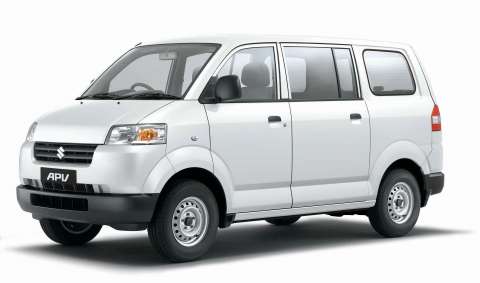
Suzuki APV Car Top Engine Series


Suzuki APV Car Top Engine Series
Suzuki APV (All Purpose Vehicle) is Suzuki's budget MPV designed in Japan and assembled in Indonesia by PT. Indomobil Suzuki International (a subsidiary of Suzuki).

At November 2007, Suzuki released the improved APV named APV Arena (APV Type II in some countries). It offers more luxurious features with the Luxury/SGX type as the flagships (captain seat version). Not just doing some facelift in exterior but also the interior is changed as well an improvement in engine performance. The APVs are exported to countries like Australia, Algeria, Aruba, Chile, India, Malaysia, Singapore, Brunei, Pakistan, Thailand and the Philippines.
Suzuki APV in use at an airport.
Manufacturer PT. Indomobil Suzuki Intl.
Production 2004–present
Predecessor Suzuki Carry, Suzuki Every
Class Compact MPV
Body style(s) Semi-bonneted Minivan
Platform Ladder Frame
Engine(s) G15A (1493 cc), G16A (1,590 cc) 16 valve MPi Inline 4, 92 bhp (69 kW) and 127 N·m
Transmission(s) 5-speed manual and 4-speed automatic
Wheelbase 2,625 mm (103.3 in)
Length 4,155 mm (163.6 in)
Width 1,655 mm (65.2 in)
Height 1,840 mm (72.4 in)
Curb weight 1,270 kg (2,800 lb)
Fuel capacity 43 L (9.5 imp gal; 11.4 US gal)
Related Mitsubishi Maven
READ MORE - Suzuki APV Car Top Engine Series

Hyundai Avega New Car Series Pictures


Hyundai Avega New Car Series Pictures
READ MORE - Hyundai Avega New Car Series Pictures

Sunday, June 6, 2010

Concept Car Porsche 911 Turbo TechArt GTstreet Model 997

Concept car Porsche 911 Turbo TechArt GTstreet Model 997Design Interior Cockpit Porsche 911 Turbo TechArt

The cockpit of the TechArt GTstreet also differs distinctly from the stock 911 Turbo. Among the differences is an exclusive leather interior with color-contrasted stitching and sporty CarboBlack highlights. The coupe is further equipped with an ergonomically shaped TechArt sport steering wheel, aluminum foot pedals, foot rest and shifter, as well as with illuminated door sills sporting the TechArt logo.

Concept car Porsche 911 Turbo TechArt GTstreet Model 997Cool Porsche 911 Turbo TechArt in the Front

German TechArt studio will present in Geneva its latest tire-burner based on the current Porsche 911 Turbo 997 series super-coupe. While most tuners focus their efforts on eye-popping exterior enhancements, TechArt’s engineers have centered their attention

Concept car Porsche 911 Turbo TechArt GTstreet Model 997Porsche 911 Turbo TechArt with based on Design

With its 2001 TechArt GTstreet, based on the Porsche 911 Turbo of the 996 model series, TechArt created one of the fastest and most powerful street-legal sports cars of its time. The next evolutionary stage of this fascinating concept celebrates its world debut at the Geneva Motor Show 2007. The new TechArt GTstreet, based on the 911 Turbo of the latest 997 series, starts at $320,000. Like the predecessor the new GTstreet edition centers on a powerful engine. The 3.6-liter twin-turbo flat engine is modified by the TechArt engine specialists and now develops 630 bhp at 6,800 rpm, up from standard 480 bhp. Peak torque increases to 605 lb-ft at 4,500 rpm.

Concept car Porsche 911 Turbo TechArt GTstreet Model 997Porsche 911 Turbo TechArt on Back Body

The TechArt GTstreet rear fascia with integrated carbon-fiber diffuser contributes to the strong downforce generated on the rear axle. It also provides the perfect backdrop for the quad exhaust of the TechArt high-performance exhaust system. TechArt Automobildesign offers a number of versions of its popular Formula wheel in sizes 8.5Jx20 in front and 12Jx20 on the rear axle. GTstreet buyers can choose from several color combinations and between the one-piece Formula and the multi-piece Formula II designs. The Formula II wheel features an exchangeable wheel lip. For optimal tires TechArt chose ContiSportContact 3 high-performance tires in sizes 245/30 ZR20 and 325/25 ZR20. The large 20-inch wheels also provide the necessary space for the especially powerful and durable TechArt high-performance brake system. It features six-piston aluminum fixed calipers and 390-millimeter discs on the front axle. The rear axle is fitted with 365-millimeter discs and four-piston fixed calipers. The TechArt GTstreet comes with a TechArt VarioPlus coil-over suspension that is based on the electronically adjustable PASM damping system of the 911 Turbo. This chassis allows individual ride-height lowering by up to 25 millimeters and push-button selection of two different damper settings, “Normal” or “Sport.” However, the dampers are not limited to these presets. Sporty driving automatically results in firmer damper settings in both modes, thus combining excellent ride comfort during normal driving with agile and responsive handling during fast cornering.


Concept car Porsche 911 Turbo TechArt GTstreet Model 997Porsche 911 Turbo TechArt in Beside

The body kit for the TechArt GTstreet was created in the wind tunnel, and offers an optimal symbiosis of aerodynamic down force, minimized drag and striking design. The front fascia of the GTstreet with retractable carbon-fiber splitter produces down force on the front axle and provides radiator, oil coolers and brakes with more cooling air, thanks to its large, striking air inlets. The auxiliary headlamp units with daytime running lights and fog lamps improve active safety. They also give the car even more passing clout. The TechArt GTstreet fender flares on the front axle add 10 mm to the two-door’s width and give it an even more dynamic appearance. But that’s not all: The air outlets behind the front wheel houses optimize brake venting. The larger air ducts in the rear sidewalls provide engine and inter coolers with a larger supply of cooling air. For an optimal transition between front and rear fenders the TechArt designers have developed rocker panels that complement the new contours. TechArt mirror and headlamp moldings provide the finishing touches. The TechArt roof spoiler extends the roof line and optimizes airflow to the adjustable rear airfoil of the GTstreet.
READ MORE - Concept Car Porsche 911 Turbo TechArt GTstreet Model 997

Tuesday, February 9, 2010

New Mégane Coupé Cabriolet with Elegant Interior Design

New Renault Megane 2010 reviewNew Mégane Coupé-Cabriolet completes the renewal style of the New Mégane family which is built on the strengths that forged the success of its predecessor. Its new appearance is supported by the large folding glass roof, high-gloss finish, black glass roof contrasts with the satin-effect chrome windscreen frame exterior, and the dark red taillights featuring a linear lighting pattern and LED brake lights to provide a distinctive rear lighting character.
With it’s new style, New Mégane Coupé-Cabriolet goes further by offering customers with unruffled open-top motoring supported by the forward position of the windscreen and a fixed glass, outstanding handling performance with a stiffer chassis and a new electric power steering system, and a broad choice of efficient and eco-friendly powertrains including the all-new automatic EDC (Efficient Dual Clutch) transmission.
New Renault Megane 2010 conceptNew Renault Megane 2010 is the best carThe interior of this New Mégane family still presents the same layout with high standard finish of qualified materials available in three choices of trim, which range from dark charcoal and light beige to the charcoal and red two-tone finish with leather seats. Although the dashboard is identical to that of New Mégane Hatchback, the seats offer additional lateral support, while the ‘butterfly wing’ door trim panel is specific to New Mégane Coupé-Cabriolet.
New Renault Megane 2010 modificationNew Mégane Coupé-Cabriolet is available with a choice of seven efficient and eco-friendly petrol and diesel powertrain configurations (depending on the market). The available petrol engines are, the 1.6 16V 110hp engine mated to a six-speed manual gearbox, the TCe 130 (Turbo Control efficiency) driving through a six-speed manual gearbox, and the 2.0 16V 140hp engine available with the new continuously variable transmission (CVT) for even greater driving comfort thanks to smooth, step-less gearshifts. While the diesel engine range, which comprises the Euro5-homologated powerplants are the dCi 110 DPF, mated either to the brand new six-speed EDC (Efficient Dual Clutch) dual-clutch automatic transmission (see below) or to a manual six-speed gearbox, the dCi 130 DPF which drives through a six-speed manual gearbox, and the dCi 160 DPF also with a six-speed manual gearbox.
New Renault Megane 2010 concept modifyPublic will get their first opportunity to see this New Mégane Coupé-Cabriolet when it is unveiled at the forthcoming Geneva Motor Show (March 4-14). It will also be displayed at L’Atelier Renault on the Champs-Elysées in Paris.
New Renault Megane 2010 imagesRounding off the new Megane family is the Coupe-Cabriolet that was formally introduced today ahead of its world premiere at next month's Geneva Salon. Like its predecessor, the new Megane CC is a two door model with an electric folding top that's mostly covered in smoked glass

The French carmaker claims the Megane CC's transparent glazed area of 0.47 sq. metres is the largest in the segment that includes cars like the Pininfarina-styled Ford Focus CC and the Peugeot 308 CC.
New Renault Megane 2010 white The four-seater convertible version of the new Megane also gets a fixed glass wind deflector located behind the back seat headrests that is said to allow draft-free driving at speeds of up to 90km/h or 56mph.
New Renault Megane 2010 popular carNew Renault Megane 2010 great interiorThe fully-automatic, electro-hydraulic operated two-piece glass top goes up or down in 21 seconds at the press of a button with the Megane CC's boot capacity standing at 417 litres with the roof closed, and 211 litres when open.

Depending on the market, the new Megane Coupe-Cabriolet will be available with a choice of up to seven gasoline and diesel powertrains.
The petrol line includes a 110HP 1.6-liter unit linked to a six-speed manual, a 1.4-liter TCe turbo with 130HP matted to a six-speed manual and a 140HP 2.0-liter with a CVT.
New Renault Megane 2010 interior best designDiesel options include the 110HP dCi matted to either a new 6-speed dual clutch automatic transmission or to 6-speed manual gearbox and the 130HP dCi and 160HP dCi that both drive the front wheels through a six-speed manual.

European sales of next generation Megane Coupe-Cabriolet will begin this spring.

New Renault Megane 2010 popular carsNew Renault Megane 2010 pictInterior design of megane cabrioet pict images
New Renault Megane 2010 interior designNew Renault Megane 2010 desigh ellegantNew Renault Megane 2010 good interior
READ MORE - New Mégane Coupé Cabriolet with Elegant Interior Design

LinkWithin

Related Posts Plugin for WordPress, Blogger...